Building the Science Behind an AI Adoption SaaS
8 minute read

Andreea Zaman
•
Context & Challenge
SocialMachines was building a SaaS product to help SMEs and scale-ups assess and improve their AI adoption readiness. The market context was compelling: research from Ipsos across more than 1,300 UK business leaders had found that leadership vision and people factors were the strongest drivers of successful AI implementation, yet most tools available to organisations focused on technology infrastructure rather than the human side of adoption. SocialMachines' founding insight was that the most advanced AI is only as powerful as the team's ability to use and trust it.
The challenge was to turn that insight into a measurement product that could be taken seriously. Existing "AI readiness" tools were largely off-the-shelf questionnaires with no clear construct validity — they measured something, but it was rarely clear what, or whether it predicted anything useful. For a product targeting SMEs with limited time and tolerance for vague recommendations, the assessment needed to be grounded in validated theory, generate genuinely differentiated outputs at the individual level, and connect clearly to business decisions. As Head of Product and AI Lead, I was responsible for the scientific and product architecture that would make that possible.
Approach
Construct architecture: Defined AI readiness as a composite of six measurable dimensions: AI literacy, AI trust, individual characteristics, organisational culture, innovation capacity, and AI capacity — each specified with clear behavioural referents rather than treated as a single attitude score
Theoretical grounding: Anchored the framework in established behavioural science models, including the Theory of Planned Behavior and the Technology Acceptance Model, to ensure the assessment could predict adoption behaviour rather than simply describe current states
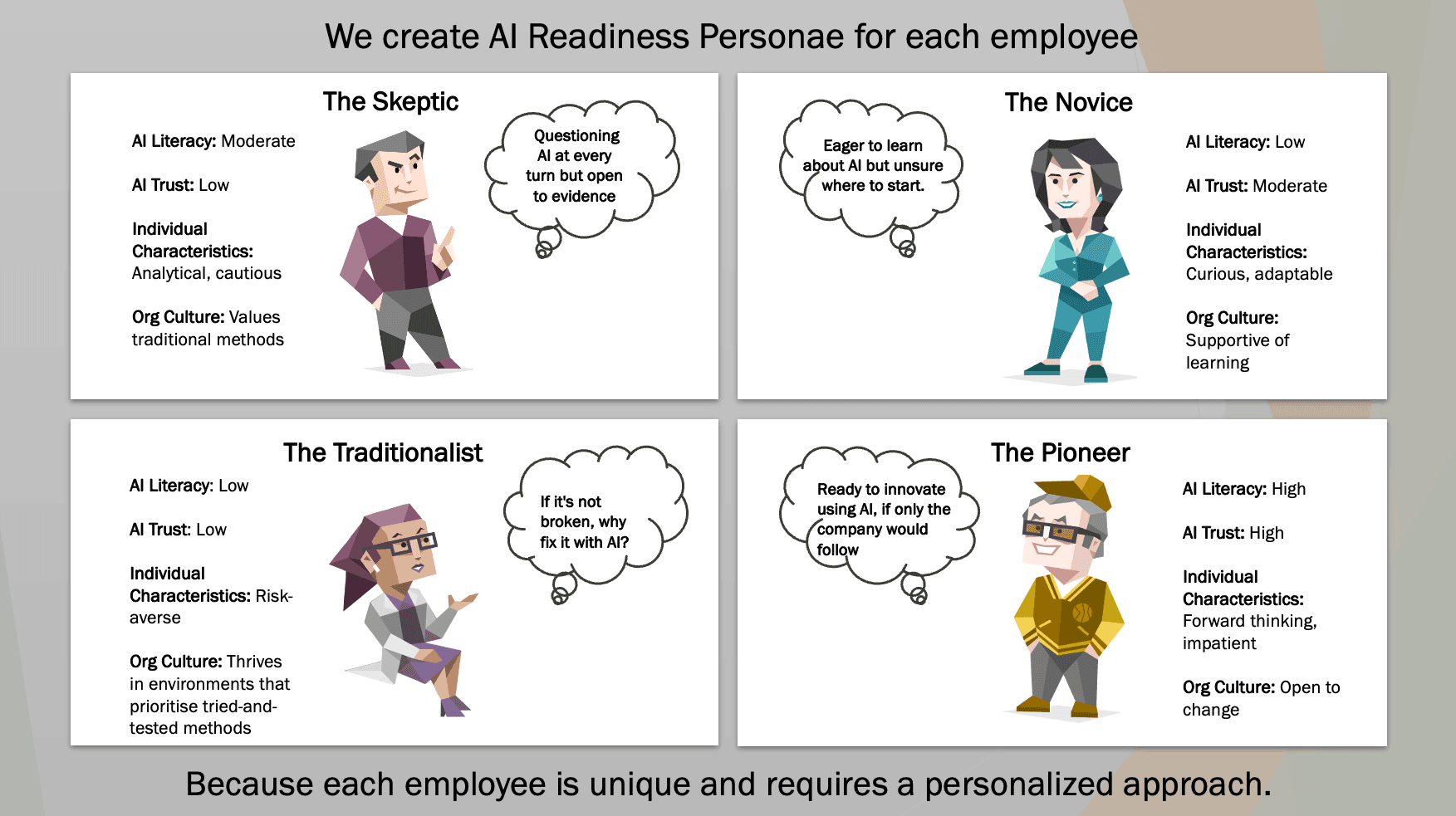
Persona development: Designed a persona-based output layer — including profiles such as The Skeptic, The Novice, The Traditionalist, and The Pioneer — to translate psychometric data into formats that non-specialist managers could interpret and act on
Intervention mapping: Linked each persona profile to a specific set of behavioural interventions, from executive AI education and peer learning to staged implementation and culture change strategies, giving the product a clear pathway from diagnosis to action
Product differentiation: Positioned the assessment explicitly against generic, technology-focused competitors by building a human-centric, customisable architecture that could be integrated with existing organisational systems
Maturity staging: Developed a four-level AI maturity model (Learning, Planning, Adopting, Scaling) to contextualise individual and team scores within an organisation's broader adoption journey, making outputs directly relevant to where a business actually was
Outcomes
SocialMachines moved from a product concept to a fully specified measurement framework with a defensible scientific rationale, distinct positioning, and a clear product structure (core SaaS plus optional consulting layer)
The persona system gave the product a tangible, communicable output format that went beyond generic scores, making it meaningfully different from competitors in sales and investor conversations
The construct architecture provided a roadmap for instrument development: identifying which dimensions required new scale development, which could draw on validated measures from the academic literature, and which would need piloting with SME populations
The maturity model created a logical structure for the SaaS product's reporting dashboard, enabling organisations to track progress over time rather than receive a one-off snapshot
The framework established a replicable, evidence-based approach to AI readiness measurement that could extend to adjacent use cases, including team-level culture assessment and leadership-specific diagnostics
Stakeholder Perspective
"Andreea brought the scientific rigour we needed to turn a sharp product intuition into something we could actually build and defend. The framework she developed gave us a foundation that held up across product, commercial, and investor conversations."
Call to Action
If you are building or investing in an AI assessment product and need the measurement science to be as robust as the technology, get in touch.